Thursday, June 21, 2012
"..and we move around like tigers on vaseline..."
The first 45 seconds is people talking, but then the guy starts to dance. And it is incredible. Having watched this now a dozen times I'm still not entirely convinced this person is an actual human male.


Sunday, June 3, 2012
Jack White Concert Review

The wife and I go to see music once a year at most. Last year we saw The Dead Weather; this year we saw Jack White. The common link is my wife's semi-obsession with Mr White. Apparently she has frequent dreams in which we both move to Nashville (I think I get to go), somehow run into Jack somewhere around town, and all become friends. So. I don't know what to make of that, but it doesn't sound promising, does it?
White played a few nights ago at the Wiltern and so we dressed up like young people and left the valley. On a weeknight. Which is basically, for us, the equivalent of dropping acid, hijacking a yacht, and spending a month cruising the Dalmatian coast.
The show was not bad. White has a likable stage presence and he's obviously a gifted musician. He also looks remarkably like Edward Scissorhands. His tour is in support of his first solo album, Blunderbuss, which is made up, apparently, of songs he's been writing over the last several years.
The band was fine, the songs were okay. My takeaway was that White needs other people who are creatively potent as himself to be in contact with. He has innate musical talent--he's one of those people that if you invented a new instrument tomorrow, he could play it well by next week--but his songwriting skills have yet to really blossom. He works mostly in fairly standards--blues or three-chord, I/IV/V, single basic repeated riff-driven songs. That's nothing wrong with any of that, but I don't get the sense, watching him, that he's pushing his own creative boundaries. What he needs is a collaborator who's as talented as he is, someone who'll challenge him to be better than he has been before.
A few nights before the concert, The Last Waltz had been on TV, and when I watched Jack White the person I thought off was Rick Danko. They're both talented musicians; they both play many instruments well; and they both have a genuine rock oddness to them. They're not trying to seem eccentric, they really are eccentric. The difference is that Danko, for whatever reason, joined his talents--for some amount of time anyway--with other people as equally talented and strong-willed as himself. The result was at least two masterpiece albums. White, on the other hand, keeps finding projects where he's the alpha dog. The resulting music is what I imagine Rick Danko's solo albums probably sound like. They're fine; they're not devoid of interest, but they're not special. White could be special--I think. But not on his own.
Friday, May 25, 2012
Predictions and Random Thoughts
Predictions
1) The Spurs over the Heat, in six games, in the NBA finals.

Van The Man
Despite the sneering disdain of my New York Intellectual friend ASWOBA, Astral Weeks remains one of my most beloved rock (rock-jazz?) albums. On that subject, I highly recommend this excellent appreciation of Morrison's work. It contains, among other things, a fascinating list of Morrison clips avialable on YouTube (which I am off to check out). A sample:
2) Bringing Tebow to the Jets was a bad idea. Massive problems will result. The Jets will finish 8-8. Rex Ryan's job will be in jeopardy. (Not all due to Tebow, of course. But he's going to exacerbate an already-bad situation).
3) Even though they're down against the Devils, I like the Rangers to win not only this series, but to beat the Kings in the Stanley Cup. Even though I'm rooting for the Kings. The only LA team worth rooting for.
Random Thoughts
Veep on HBO is exactly what I feared it would be. Cynicism masquerading as wit. Worse, cynicism masquerading as wisdom. No surprise, I guess given that two of the main producers are the ever-bilious and horrible Frank Rich, and the guy behind In The Loop. It's the same problem I have, in some ways, with Mad Men. Making every character on a show base and selfish is just as shallow and unconvincing as making every character a noble, selfless would-be saint (see The West Wing). Humans aren't always, only motivated by fear, careerism, and selfishness. It's irksome.
Also irksome, though for many different reason, in the much-ballyhooed Girls, also on HBO. I don't yet know what I think of this show. It goes from impressing to bothering the living hell out of me every time I watch it. One of its core problems, I think, is that the suffering of its main character, Hannah, rarely transcends her own place and time. We sometimes feel for her, but we rarely feel _with_ her. At least, I rarely do. And, I don't get why every single sex scene in the entire show has to strive to attain the maximum level of cringe-inducing awkwardness. Jury's still out, I guess. My favorite moment in it so far has been the scene between Hannah and her now-gay ex-boyfriend. THAT was funny-and also, somewhat moving. Wish the show had more of that.
Van The Man
Despite the sneering disdain of my New York Intellectual friend ASWOBA, Astral Weeks remains one of my most beloved rock (rock-jazz?) albums. On that subject, I highly recommend this excellent appreciation of Morrison's work. It contains, among other things, a fascinating list of Morrison clips avialable on YouTube (which I am off to check out). A sample:
I recently edited a book titled The Neuroscience of Preference. Unsurprisingly, this got me reflecting on my own preferences. It was hard to avoid the conclusion that few have endured the ebb and flow of time. In fact I often experience what I suspect is a common phenomenon: private embarrassment at these temporal disjunctions in taste. A recent example was seeing a model of car that I owned in the late 1970s. At the time it seemed desirable and the essence of modernity. What presented itself to my eyes all these years later was nothing short of a hideous box awkwardly balanced on four wheels. When it comes to preferences, an awful lot of them are evanescent, a fact that is perennially exploited by the fashion industry.
At the same time, I have to acknowledge that there are some constants. For me, one of these is an enduring passion for the music of Van Morrison. No other human voice has such power to arrest my attention and compel me to listen. This is a preference that has endured for more than 40 years.
Friday, May 18, 2012
Of Course. Who Wouldn't?

"Bertie, you're extraordinary," she said.
"Eh? How do you mean, extraordinary?"
"All this nonsense you have been talking, trying to reconcile me and D'Arcy. Not that I don't admire you for it. I think it's rather wonderful of you. But then everybody says that, though you have a brain like a peahen, you're the soul of kindness and generosity."
Well, I was handicapped here by the fact that, never having met a peahen, I was unable to estimate the quality of these fowls' intelligence, but she had spoken as if they were a bit short of the grey matter, and I was about to ask her who the hell she meant by 'everybody,' when she resumed.
"You want to marry me yourself, don't you?"
I had to take another mouthful of the substance in the bottle before I could speak. One of those difficult questions to answer.
"Oh, rather," I said, for I was anxious to make the evening a success. "Of course. Who wouldn't?"
Friday, May 11, 2012
Sebald Is As Good As Advertised

But the more I labored on this project over several months the more pitiful did the results seem. I was increasingly overcome by a sense of aversion and distaste, said Austerlitz, at the mere thought of opening the bundles of papers and looking through the endless reams I had written in the course of the years. Yet reading and writing, he added, had always been his favorite occupation. How happily, said Austerlitz, have I sat over a book in the deepening twilight until I could no longer make out the words and my mind began to wander, and how secure have I felt seated at the desk in my house in the dark night, just watching the tip of my pencil in the lamplight following its shadow, as if of its own accord and with perfect fidelity, while that shadow moved regularly from left to right, line by line, over the ruled paper. But now I found writing such hard going that it often took me a whole day to compose a single sentence, and no sooner had I thought such a sentence out, with the greatest effort, and written it down, that I saw the awkward falsity of my constructions and the inadequacy of all the words I had employed. If at times some kind of self-deception nonetheless made me feel that I had done a good day's work, then as soon as I glanced at the page next morning I was sure to find the most appalling mistakes, inconsistencies, and lapses staring at me from the paper. How much or little I had written, on a subsequent reading it always seemed so fundamentally flawed that I had to destroy it immediately and begin again. Soon I could not even venture on the first step. Like a tightrope walker who has forgotten how to put one foot in front of the other, all I felt was the swaying of the precarious structure on which I stood, stricken with terror at the realization that the ends of the balancing pole gleaming far out on the edges of my field of vision were no longer my guiding lights, as before, but malignant enticements to me to cast myself into the depths.
Friday, May 4, 2012
The SAT is Tomorrow. That Affects None of You, I Know
Sorry for the long radio silence. I've been teaching and writing, mostly the latter. The wife and I are going on a mini vacation to the Napa Valley next weekend, and I'm trying to reach a certain writing threshhold before then. For the last two weeks it seemed impossible that I was going to meet that threshold, but something good seems to have happened finally and it's looking sunny.
I'll try to take some photos in Napa and do another foodie write-up. We're going to The French Laundry, which should be a highlight. Also going to stay at place with a nice pool and view and so forth, so it should be relaxing. Not that I ever really relax. But, I should be less anxious, at least.
More to come, soon, I trust...
I'll try to take some photos in Napa and do another foodie write-up. We're going to The French Laundry, which should be a highlight. Also going to stay at place with a nice pool and view and so forth, so it should be relaxing. Not that I ever really relax. But, I should be less anxious, at least.
More to come, soon, I trust...
Wednesday, April 18, 2012
Time to Play?

This article about married, middle-aged men who attend "My Little Pony" fan conventions is a memorable read. Sample:
Isn’t there something a little weird about grown men playing with rainbow-hued ponies? Pamela Rutledge, director of the Media Psychology Research Center, doesn’t think so. She says, “They’re just a fan base revisiting childhood and some of the things they have left behind” — and, in some cases, the things they didn’t get a chance to experience the first time around, such as brushing a pony’s synthetic mane.
It’s escapist in a positive way, she says: “It really is just different ways people have of fulfilling these very fundamental human needs.”
For all his flamboyant pony shirts, R.S. has received surprisingly little flak. “I would’ve thought it was weird — I did think it was weird, when my friend first told me about it,” R.S. says. “But no one cares.” And if he ever did feel ostracized? He shrugs and spreads his hands. “Haters gonna hate, you know?”
Monday, April 2, 2012
For Johannes

I then went down the hall to join Madeline Bassett...
"Oh Bertie," she said in a low voice like beer trickling out of a jug, "you ought not to be here!"
....She went on, looking at me as if I were a rabbit which she was expecing shortly to turn into a gnome.
"Why did you come? Oh, I know what you are going to say. You felt that, cost what it might, you had to see me again, just once. You could not resist the urge to take away with you one last memory which you could cherish down the lonely years. Oh, Bertie, you remind me of Rudel."
The name was new to me.
"Rudel?"
"The Seigneur Geoffrey Rudel, Prince of Blaye-en-Saintonge."
I shook my head.
"Never met him, I'm afraid. Pal of yours?"
"He lived in the Middle Ages. He was a great poet. And he fell in love with the wife of the Lord of Tripoli."
I stirred uneasily. I hoped she was going to keep it clean.
"For years he loved her, and at last he could resist no longer. He took ship to Tripoli, and his servants carried him ashore."
"Not feeling so good?" I said, groping. "Rough crossing?"
"He was dying. Of love."
"Oh, ah."
"They bore him to Lady Melisande's presence on a litter, and he had just strength enough to reach out and touch her hand. Then he died."
She paused, and heaved a sigh that seemed to come straight up from the cami-knickers. A silence ensued.
"Terrific," I said, feeling I had to say something, though personally I didn't think the story a patch on the one about the traveling salesman and the farmer's daughter. Different, of course, if one had known the chap.
Monday, March 12, 2012
Vegas Recap II
Blackjack
There then emerged a situation. The waitress, was, let us say, in a mood. A mood which was not a mood of happiness. A mood which she took out on the pit boss. I think her complaint was that he hadn’t been polite enough in summoning her, but mostly she was just...not happy to be there at that moment. She yelled at him. Something about how to talk to a lady, I think. (To which I considered responding: does a “lady” wear fishnet tights, a bustier, and bring men alcohol for money? But I did not. I may have been tipsy, but I’m not a moron.)
One lesson I take from our last trip: if you’re going to drink, the first night may not be the best night. Another lesson: if you’re going to drink, play blackjack. That’s how to win!
Or at least, that’s how we won. I have long ago forgotten all the ‘correct’ plays to make in blackjack (“Basic Strategy” as it’s known). There’s no need to remember them; any dealer will tell you the correct play whenever you ask. This frees up the mind for more important tasks, like trying to find a cocktail waitress. Or, making conversation.
For some reason when I drink I start to believe that there exists a unique understanding—a bond almost--between myself and Casino workers (especially those who run the games). In an alternate life, I guess I somehow imagine that if things go badly, that’s what I’d end up doing. Pit bosses and dealers are always slightly bored; conversing with the tourists, I assume, is the best part of the job. (Friendly tourists, I should say. Dealing with the jerks who abuse the dealers when they lose money is surely the worst part of the job. But that is not my way. It doesn't even make any sense. How can you get mad for losing money? Of course you’re going to lose money. That’s the point of a casino.)
Anyway, by the time we found a few seats at a 15$ blackjack table, I had enough alcohol and hazelnut flavored chocolate in me to feel, renewed with me, my powerful fellowship with the folks who run casino games. As soon as we sat down, I struck up a conversation with the pit boss. I first tried to talk to the dealer but he didn’t have much of a personality. (At least, I didn’t think so. He and The Wife-al Unit got along quite well). Eventually, though, I started to become sober. Sensing the danger in that state, I politely asked the pit boss if he could find us a cocktail waitress.
He agreed it had been slow and flagged down a waitress.
He agreed it had been slow and flagged down a waitress.
There then emerged a situation. The waitress, was, let us say, in a mood. A mood which was not a mood of happiness. A mood which she took out on the pit boss. I think her complaint was that he hadn’t been polite enough in summoning her, but mostly she was just...not happy to be there at that moment. She yelled at him. Something about how to talk to a lady, I think. (To which I considered responding: does a “lady” wear fishnet tights, a bustier, and bring men alcohol for money? But I did not. I may have been tipsy, but I’m not a moron.)
Anyway: the pit boss was polite, and the waitress was not. She did take our drink orders, at that point, though. And in fact, from then on, service was quite good. Although, in all honestly, that may have been a mixed blessing. Anyway, after the situation ended, and the waitress left, I complimented the pit boss on his equanimity. We moved on to other subjects. A few minutes later we learned that the waitress had lodged a complaint with the floor manager (!) about the way the pit boss had talked to her.
Having heard the entire exchange, and feeling like it was definitely a good situation for me to involve myself in, I volunteered to testify to whoever I needed to that the pit boss had been a complete professional. Then, a bit later, the floor manager arrived and did, in fact, ask me for my version of the events. I told her I thought the pit boss had behaved with perfect decency and she said (the floor manager) that’s what she’d assumed (“she knew what a good guy he was”), and that had been that. But, it was some fun drama.
Having heard the entire exchange, and feeling like it was definitely a good situation for me to involve myself in, I volunteered to testify to whoever I needed to that the pit boss had been a complete professional. Then, a bit later, the floor manager arrived and did, in fact, ask me for my version of the events. I told her I thought the pit boss had behaved with perfect decency and she said (the floor manager) that’s what she’d assumed (“she knew what a good guy he was”), and that had been that. But, it was some fun drama.
I mean, I think that's how it happened. During all this I drank many many vodka tonics. So who really knows? I do think my wife seemed embarrassed by my loud boisterous BS-ing with the various casino people. I know: How could that be? And yet, that is my memory of the evening.
When it was all over, I learned we’d somehow won 300$. That was the most shocking event of all. As I told my new friend Pit Boss I (Matt?) as I got up, “I didn’t know you were allowed to win money at a casino.” I think most of it came from one hand in which I split nines against a dealer eight, got dealt another nine, split that, and then got dealt, on the first and third nine, a two, requiring that I double down. So that by the end of the hand I had a least 100$ on the table. And the dealer did then bust. And there was much rejoicing.
On the other hand, we may have won solely because my wife, after an hour of playing 'correct' basic strategy, decided she was going to start making the plays SHE wanted to make. (Or, as our grouchy dealer said of her, admiringly, "you are not playing by THE book: you are playing by YOUR book." Which is more true than he knows.) That was some good times. The looks of horror on the faces of the other people at the table as the wife tried a hit a sixteen against a dealer's five. (I think I talked her out of that?) Her creative, some might say haphazard, plans for doubling down. Her fearlessness when hitting to a seventeen. It was something.
Poker:
After a long night of revels, I spent Saturday playing poker. Usually, when I used to go to Vegas, I typically played 2/5 or even 5/10. After Friday night, however, I had no capacity for any game that required actual thought. That left 1/2. I was dazed, hungover, and half asleep for most of the day; at 5/10 that would have hurt my game. At 1 / 2 it helped.
At those stakes the only ‘skill’ you need is patience. You wait to get a hand, you bet it, and you rake the chips. It’s hard to sit for hours at a time with donkeys folding medium strength hands; when the fountain of money is so nearby, the temptation is to reach for it, bucket or not. But no one folds in 1/2 and fancy moves avail you naught. You have to have hands. You can’t force things (my usual problem at those stakes).
But force things I did not. Force of any kind was not, at that time and place, my metier. And in part I was so patient (i.e. 'tired') I managed to make a pretty sizable win (at least for those stakes). It probably also helped that I haven’t watched poker on TV in the last several months. Watching pros make fancy plays at each other always inspires me to do the same. And fancy plays are losing propositions at 1/2 . (Last time I was in Vegas I check-shoved a river for an all-in bluff, representing a straight against top pair. I got called in about two seconds. Sigh.)
It helped that I got dealt some real hands. Even more important, I got dealt them at the same time that the table donkeys decided to spew off chips. I doubled up early on by making a full house against someone who had top pair (and who refused to fold). Then, an hour later, I raised AJ in the CO and got the big blind to check raise me all-in on a flop of A/J/5. (He had queens!) A jack high flush an hour later saw my 300$ buy in rise to 800.
Feeling a little more mentally acute, I switched, that afternoon, to Pot Limit Omaha (a game the Venetian now spreads every day—how things have changed). PLO is not a game of amateurs; the tables were filled with serious looking dudes wearing headphones and sunglasses. Still, I think I have at least some edge in that game, and when I managed to get my top two pair on the flop to hold up against a big stacked calling station, I ran my day’s total win up to more than 1000$.
Sunday was more of the same. Patient ABC poker while I waited for the donkeys to make mistakes. Again, I chipped up steadily. Did I make any interesting plays? Two that I can remember. The first involved a float against a massively aggressive player which I turned into a pot sized bluff on the river after a flush card hit. That got him to fold. I also made one good call-down based on a read. UTG, I open limped 77, when an aggro guy behind me raised to 17$. I called and dark-checked the flop. It came nine-high; he bet 30$, and I called. The turn was a blank: I checked and he checked. The river was a queen. He hesitated and then bet 50$. I called quickly and he mucked what I’m sure was AK. Not a hero call by any means (his turn check made it much easier), but it was helped by a hand he’d played earlier, in which he raised the same 17$ and ultimately tabled AK. He’d varied his raise size all day, but the only time it had gone as high as 17$, he’d shown AK. That made the call down easy.
Saturday, March 10, 2012
Vegas Recap I
Sorry this has taken so long to put up. I strained a muscle in my lower back a few days ago. Since then I’ve been doing nothing but lying down and walking; for some reason sitting in chairs—especially my computer chair—hurts terribly. It’s starting to heal, however, so I’m going to try and man up and get this out to my devoted worshippers.


It will be in two parts. The first will be food; the second gambling. Since the food was the main reason we went I guess I’ll start there.
* * *
We had three dinners in Vegas; two, near-sublime and one so poor it must never be discussed or thought about again (summary: don’t ever ever go to Olive Restaurant by Todd English, in the Bellagio. Ever.)
The first night we ate at Sage, in the Aria. It was phenomenal. Four and a half of five stars. Well, maybe five out of five. Flawless. The highlight was a savory dumpling filled with chicken confit and truffles. As I told my wife: it was almost dirty. Her take ("it’s the kind of dish you’d like to take a bath in") also rang true. Also tried an intriguing new desert wine—a sparkling chilled Italian rose that’s a mix of Moscato and another grape I can’t remember. Also exceptional. The half bottle of White Burgundy we had with our first course was also memorable. That’s my favorite wine right now; it’s acidic, it’s mineral-y, and it tastes of limestone. Cold, liquid, euphoria-inducing limestone. The best kind.
After dinner, I had many vodka tonics. And we won money playing blackjack and the wife made friends with the dealers and I the pit boss. And there was much rejoicing. Except when the pit boss got in trouble and I had to testify in his defense with the floor manager. But that’s a story for later.
The next night was the big blowout. E—the reason for the trip.
As I said in an earlier post, to begin the meal at E, you go to the desk of the restaurant enclosing E (Jaleo) and present the hostess with your golden ticket. Actually you don’t have to flash the golden ticket; you can just give your name. But what the hell is the fun of that? Before we left—both for the restaurant and for the trip itself—my wife reminded me to bring the Golden Ticket. (As if they wouldn’t have let us in without it. But in a way, they shouldn’t have.)
A special E attendant emerged and seated us in a special area (we couldn't enter the dining room until we'd all assembled; all the people eating dinner must enter at the same time). Another couple waiting for E was already there, and we sat and made foodie small talk. They’d been pretty much everywhere (Del Posto, Per Se, Alinea, Next, etc) but their favorite, they said, remained the French Laundry. Which we now going to, in May. (Well, if we can get a table).
One of the waitresses from E came out while we waited to tell us about the drink options. We both chose to do the alcoholic pairings (they also have a non-alcoholic pairings, which seemed to involve lots of complicated fruit blends). Eventually the other two couples arrived (all couples the night we were there) and we eight were escorted inside.
The dining room was about the size of a bedroom. In the middle was a raised, semi-circular counter/bar, with eight chairs around it. You eat facing forward, in order to watch the chefs behind the counter prepare their various concoctions. Actually, a lot of it is done in the kitchen, but the final plating stage of most dishes occurs while you watch. This allows the head chef (or director, really) to tell you what’s going on and answer any questions. The whole thing is designed to be interactive—they purposefully under-describe the dishes when they’re presented to encourage the guests to ask them questions. And in fact, the dialogue back and forth with the head chef/food director and the sommelier/drink director was thoroughly enjoyable. Both were earnest, laid-back guys in their early 30s; they took food seriously, but they also had a sense of fun about them. It wasn’t like going to a temple. It was like going to a theater.
In fact—and I think this is telling—at one point, we asked the chef/Emcee/director how many of these meals he had prepared. In the process of figuring out the answer, he said something along the lines of ‘we (the restaurant) are dark three days a week….” That said it all—that he was using the language of theatre to talk about working in a restaurant. At the end, when the meal was done, the servers and chefs (about ten in total) all filed out of the kitchen and stood before us and bowed while we applauded (lightly). It seemed appropriate.
But what about the meal? It was pretty damn incredible. As you’d expect with any meal that lasted two hours and featured fifteen courses, it was not uniformly perfect. But, both my wife and myself had bites we’ll always remember. (“Course”, by the way, is misleading—really they were more like ‘bites.’ No course took more than two bites to finish, and many of the courses were single bites. So while you definitely left the restaurant feeling full, it wasn’t excessive. Or at least, not excessively excessive).
Jose Andres’ style is similar, I’m told, to that of his mentor, Ferran Adria. So, while the techniques are often bizarre, the food itself is inspired in large part by basic, everyday Spanish street food. The mood, the attitude, is of whimsy and playfulness.
So, for example, the first drink of the evening was a gin and tonic—except that it was a gin and tonic sorbet. To make it, the chefs used liquid nitrogen, filling the room with the same kind of smoke you might expect at the start of a Whitesnake concert. It was one of the evening’s many deliberate theatrical touches .
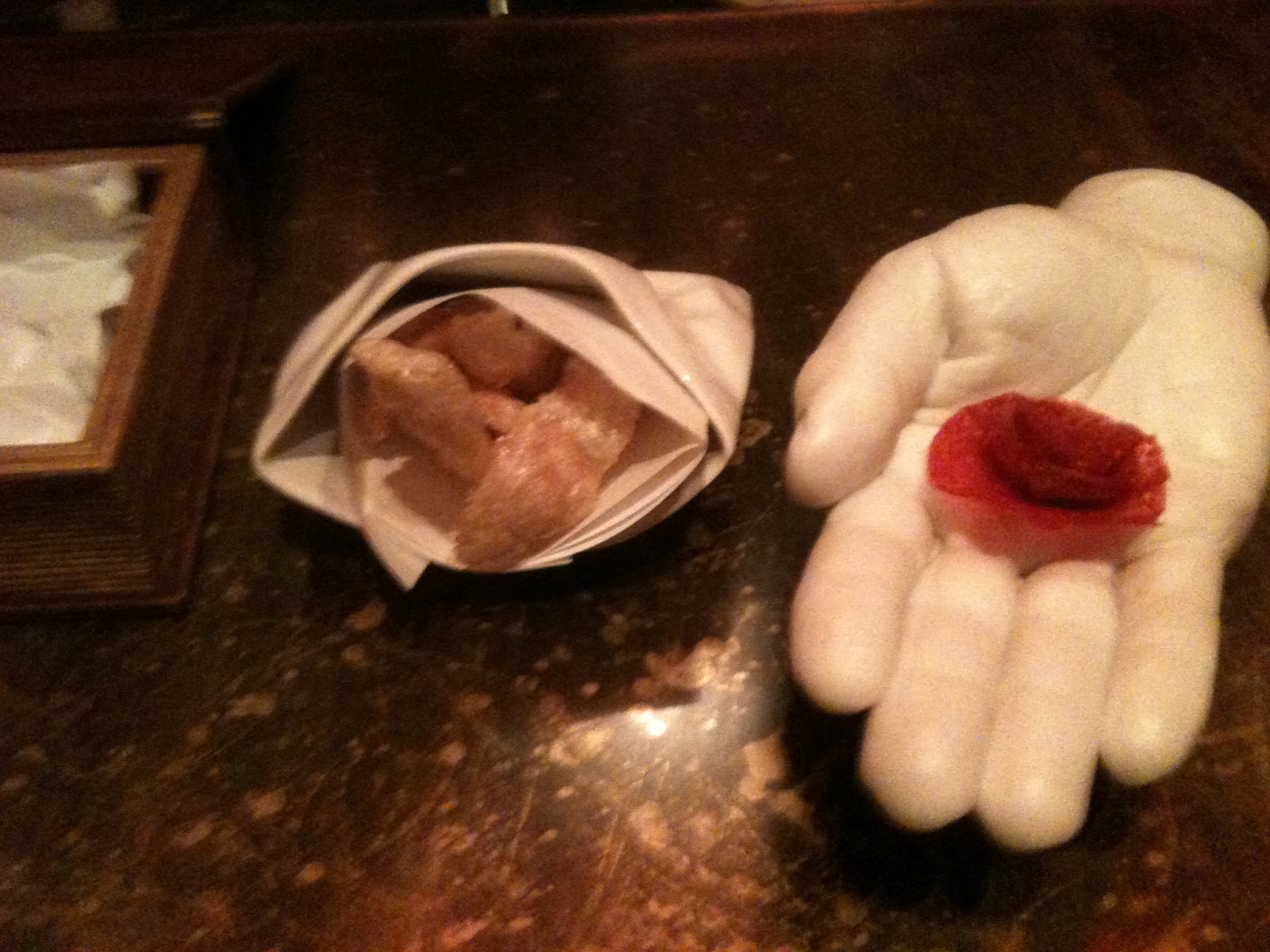
Speaking of theatrical…. this is a picture of the evening’s first food course. The hand, supposedly is a life-sized model of the hand of Jose Andres. The ‘flower’ resting on top of it is actually a kind of raspberry paper-lace. It was made with, and tasted like, raspberries, but it had the texture of…I don’t know. A communion wafer? Except one that was shaped into a flower. Hard to really capture what it felt like to eat. At the far left of the photo you can see the edge of a box. Here’s the whole box:

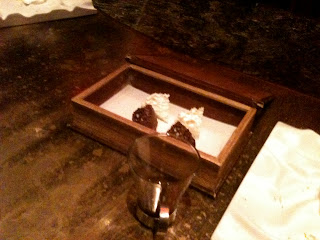
The ‘earrings’ inside are not, as you would expect, made of human ears (wait, what?) but beet skins. Crispy beet skins, obviously. In the white bag between the hand and the earrings (sounds like a good first line of a murder mystery), are chicharrones—fried pig skins. The paper bag is meant to evoke the idea of street food; because if you were on the streets of Madrid at three in the morning and decided to buy some fried pig skins drizzled in honey this is how it would be served. At least, that’s what they told us. (If you decided to buy crispy beetskins at Madrid at three in the morning, they would not, however, be shaped like earrings and served in a wooden box. They’d be shaped like unicorns and served in a burlap sack. Something to keep in mind).
Another way this whole thing was like going to a show: we were forbidden to use flash photography. Even had the lighting been better, pictures don’t really do justice to the experience of eating turbot in bone marrow sauce, on a super crispy plank of turbot skin; or of trying to drink cava out of…well…this:

The liquid in the bottom is cava. The vessel itself is, we were a told, a riff on a traditional Spanish drinking implement. The goal is to make it easy to share alcohol among large numbers of people. It’s kind of awesome that the need for everybody to get drunk off not only the same liquor but the same BOTTLE of liquor seemed, to someone, so pressing that they had to create a pitcher solely dedicated to that purpose. This is why Spain would be both much more fun and much less productive a place for me to live.
The goal, as you might surmise by looking at it, it to literally pour the alcohol down your throat without ever touching the vessel to your mouth. (For some reason this reminded of all the drinking done out of wineskins in The Sun Also Rises. Also, probably, because Hemingway had so many scenes in his novels involving earrings made of beets.)
After the sommelier gave each couple one of these pitcher things, the chef gave us a demonstration of how to use it. Then, they gave us all white napkins—in case we spilled on ourselves while drinking and needed to wipe up. (Really). There followed, then, a lacuna. And we sat, all of us, eying the cava with fear. Fear only? No--for there was also longing, there, amidst the fear. But mostly, there was fear. And then one among us, the bravest of the lot, raised the flask and poured it mouthward. And the ice was broken. And all of us did drink. And that brave soul—the first among us to face that daunting obstacle--that was my FRICKING WIFE.
And I was sore in love.

This is a lobster dish, obviously. But note the shape of the plate. Ferran Adria had it specially designed. The ridges and undulations are intended to make it easier to scoop sauce on your fork. The white stuff in the corner, by the way, is a foam—lemon flavored, I want to say. The meal involved a fair amount of foams. The best one flavored with thyme and came with a chicken dish so unbelievably delicious that I would happily travel back to Vegas tomorrow for the chance to eat it again.
One nice feature of E that I forgot mention in earlier posts: they customize the menu to your needs. So before we even arrived, the restaurant sent us a form asking us to list any foods we didn’t. (In our case, this meant cheese). Then, when they got to the two courses involving cheese, they altered for us. That was kind of neat. Especially because one of the cheese courses involved eating a sausage sized cylinder of what looked like and felt like Styrofoam. Except it tasted good. (Really).
My one minor complaint about the meal was that it went a little heavy on the desserts. Below you see one of our four (or five?) dessert bites. It’s made with the consistency of paper; you pull it apart like it was cotton candy; the flavor, however, was chocolate (I think?):


Here’s another dessert. They tended to serve a lot of things in little boxes, now that I look back on it.
At the end of the meal, they gave us all numbers which tell you where you lie in the history of the diners who’ve been before (I was diner 3060, for example). We got to write our thoughts on the meal in a book, which we’re told Jose Andres would ultimately read. Oh—and they typed out our check on a small hand-typewriter, right there in the room. That was kind of neat.
So was it worth the money? Given it was the most expensive meal the wife and I have ever had, you might think not. And if the cost was judged solely on the basis of the food, I might say no. (But then again, I might not. The food was outstanding). The thing with E, though, is that you’re not paying only for the food; you’re paying for the theater. You’re paying for the boxes, and the plastic hand, and the funky plates, and the liquid nitrogen. You’re paying to be able to ask the chef whatever you want, whenever you want, or BS with the sommerlier about the restaurants nearby. And given all that, the price is more than fair.
Not to say it’s a place you’d go to often. The menu, it turns out, gets changed every three months; they rotate in five or six new dishes, so that by the end of a year it’s altogether different. I asked how new dishes were dreamed up; anyone who works there can propose a new dish, but they have to be tested and tasted by Andres before they’re added to the menu.
Friday, March 2, 2012
Worthwhile Read on Foodie Culture
I'm still working on the Vegas recap, with particular attention to the meal at E. In the interim, anyone who's interested in Ferran Adria, El Bulli, molecular gastronomy, or foodie culture in general might enjoy this article in the Los Angeles Review of Books.
A sample:
A sample:
The rush to assess Ferran Adrià’s place in culinary history started long before El Bulli closed. There is no question of his influence, which is broad and, in some facets, sure to last. The dishes and techniques originating at El Bulli are a major part of how he will be remembered. The books, films, and multilingual website cataloguing his work provide a remarkable record of a long, fertile period. Their impact is already apparent in kitchens everywhere, sometimes in a gratifying way and sometimes with a bit too much enthusiasm. Michael Laiskonis, the former Le Bernardin pastry chef, remembers first encountering Adrià’s books as a young chef and having to “put them away” due to the threat of getting too swept up in them.
More significant than the artifacts themselves is the spirit of openness behind sharing them. If early reports are any indication, El Bulli’s next incarnation will extend this still further, with daily reports on work at the taller posted to the website. It seems appropriate that this news brings to mind a former El Bulli stagiaire. René Redzepi went on to become chef and co-owner of Noma in Copenhagen, now generally regarded, in the wake of El Bulli’s closing, as the world’s finest restaurant. Redzepi holds weekly developmental sessions with his kitchen staff and shares the results of their work in real time, via Twitter. As for Adrià’s work, and largely thanks to his General Catalogue, chefs all over have unprecedented access to his ideas, and the effect has been galvanizing. A sense of possibility, of permission to attempt the improbable (and fail at times) has swept kitchens worldwide. Even chefs with firmly established reputations, like Terrance Brennan, whose Picholine in New York has held two Michelin stars, view this changed climate with admiration, calling this the most exciting time he can remember for young chefs. And despite the fact that he is a decorated chef, firmly in mid-career, Brennan has quietly adopted techniques from Adrià that fit his own personal style.
But as with a seismic shift in any creative discipline, Adrià has his detractors. The Spanish chef Santi Santamaria, who held three Michelin stars of his own, criticized Adrià as part of “a gang of charlatans who work to distract snobs,” and questioned the use of what he called “emulsifiers and chemical agents,” suggesting they place diners’ health in danger. A similar concern with additives comes from food writer Jörg Zipprick, who has called Adrià’s food artificial. Curiously, Lisa Abend notes that a number of the stagiaires she followed at El Bulli tell her they want to cook “real food” in the future, despite their admiration for Adrià and their desire to learn from him. Misgivings or not, Adrià’s influence will not be undone at this point. Neither will chefs who refuse to embrace these new ways end up deemed Luddites; there’s always an audience for those espousing purity and simplicity, whatever the field.
Subscribe to:
Posts (Atom)